
Financial freedom isn’t about the size of your bank account, but the breadth of your choices. It’s the peace that comes when your money serves your life, not the other way around. This isn’t a one-time goal but a lifelong practice of mindful stewardship. Every financial decision you make is a vote for the kind of life you want to live.
As Warren Buffett advises, “Do not save what is left after spending, but spend what is left after saving.” This simple inversion is the foundation.
The Two Pillars of Financial Peace
The journey rests on two core principles: mindful spending and intentional investing. Most people get this backward, chasing more income to fund more spending, forever trapped on a hamster wheel.
1. Your Spending: The Art of “Enough”
The responsible spender doesn’t ask, “Can I afford this?” but rather, “Does this add value to my life, or just clutter?” This is minimalism in finance. The joy of a simpler life—rich in experiences and time with loved ones—is a currency that never depreciates. As Socrates observed, “The secret of happiness is not found in seeking more, but in developing the capacity to enjoy less.”
2. Your Investing: Plant a Garden, Don’t Chase Rainbows
Investing is a process of cultivation, not a game of chance. The key is to adopt a long-term vision. Market cycles are inevitable; trying to time them is a fool’s errand. Instead, focus on time in the market.
The Power of Mutual Funds: For most investors, mutual funds are the perfect vehicle to execute this long-term strategy. They offer instant diversification, professional management, and accessibility with small amounts. Instead of risking your fortune on a single “sure-shot” stock, you own a small piece of hundreds of companies. This dramatically reduces your risk and the emotional burden of investing.
Think of it this way: Would you rather bet on one horse, or own a small share of the entire racecourse?
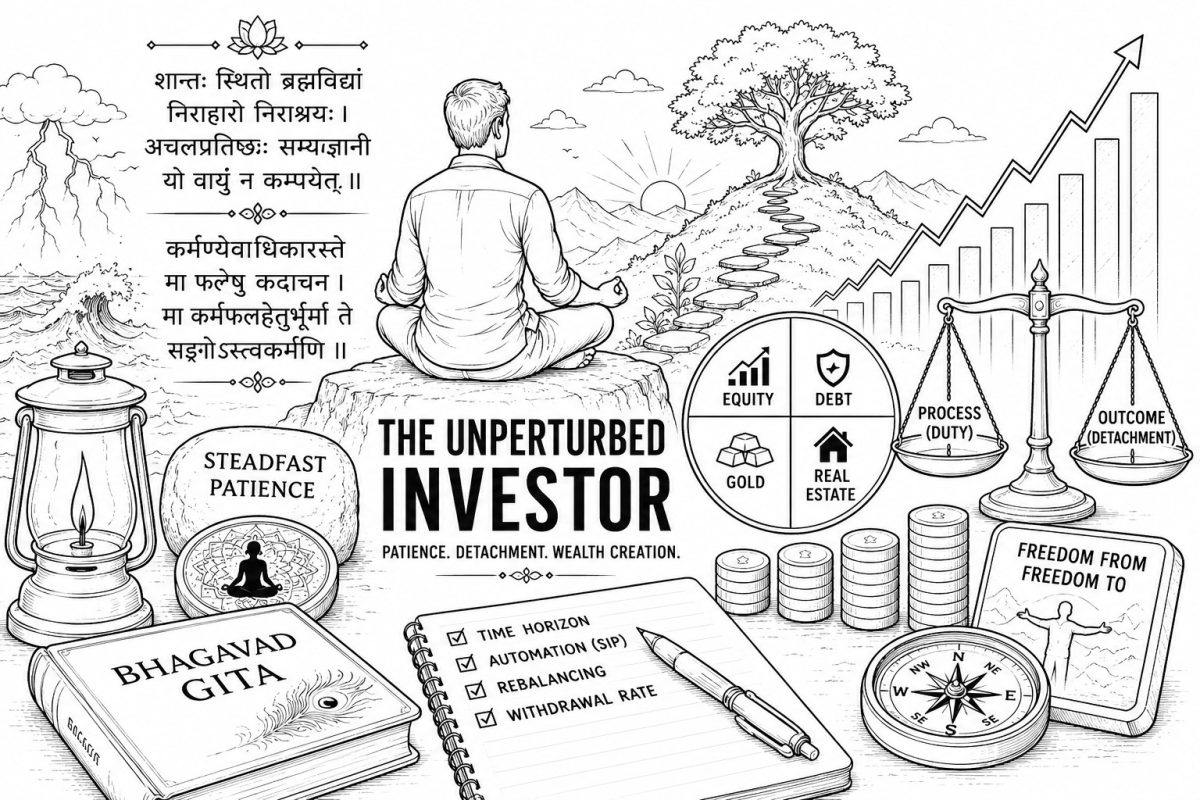
The data is clear: a long-term, disciplined approach in diversified assets like equity mutual funds has historically weathered every storm and generated significant wealth. The freedom lies in setting up a systematic investment plan (SIP) and then letting compounding do the heavy lifting. “The stock market is a device for transferring money from the impatient to the patient.”
The Unseen Foundations: Protection and Simplicity
True financial peace requires securing the foundation.
Debt: The Illusion of “Easy” Money. Debt is a tool that easily becomes a trap. “Beware of little expenses,” Benjamin Franklin warned, “a small leak will sink a great ship.” The less debt you carry, the more your income is yours to keep and invest.
Family: The Ultimate “Why”. Your financial plan is incomplete without protection. This means the basics: a simple will, adequate term life insurance, and clear instructions. Simplifying your assets ensures your family inherits a blessing, not a burden.
The Takeaway: Freedom is Found in Less
The ultimate wealth is the ability to live life on your terms. This is achieved not by accumulating more, but by expertly managing and appreciating what you have.
By spending mindfully, investing patiently through simple, long-term vehicles like mutual funds, and simplifying aggressively, you build a life where money is a quiet, reliable background player. You declutter your finances to declutter your mind. The journey to financial freedom is, ultimately, the journey to a simpler, more intentional life.