
The Spectacle and the Strain
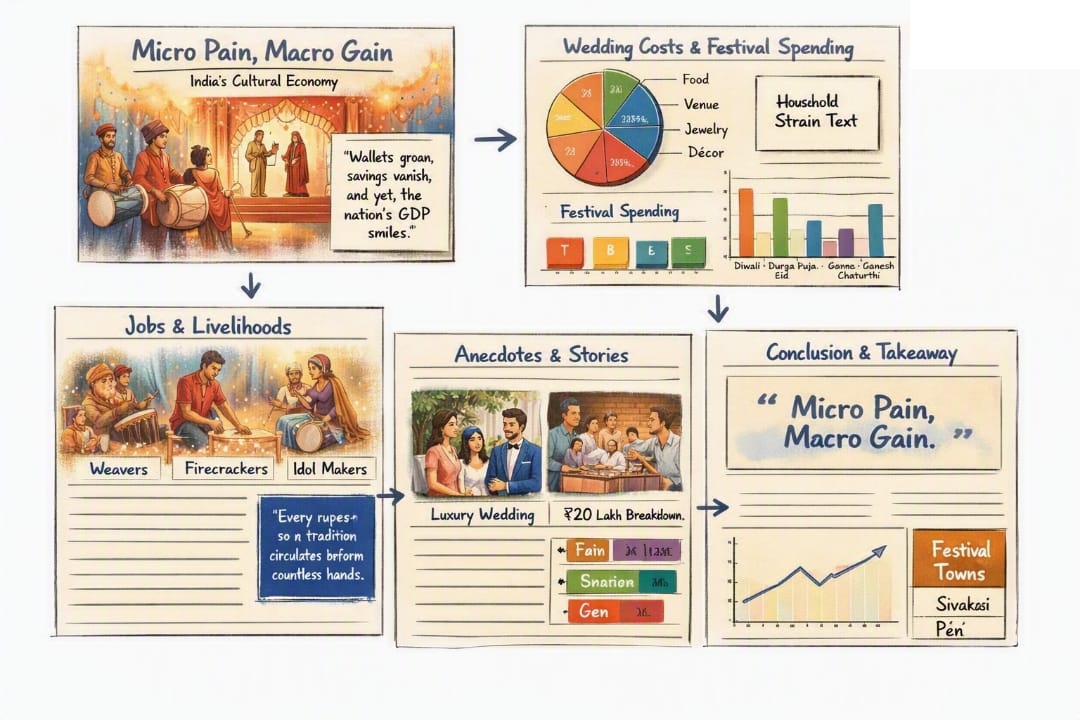
“Wallets groan, savings vanish, and yet, the nation’s GDP smiles.”
In India, a wedding is not just a union of two souls — it is an economic carnival. Every firecracker burst in Diwali, every garland strung in a marriage hall, every sweet box exchanged in Eid is more than ritual — it is commerce, employment, and growth disguised as tradition.
Families, of course, feel the pinch. Weddings today average between ₹39–58 lakh, with food, venue, and jewelry swallowing most of the budget. Festivals bring joy but also push households into seasonal overspending, often beyond what was planned. For many, savings disappear or loans pile up — the “micro pain” of tradition.
The Numbers Behind the Joy
– Wedding economy: Worth nearly $130 billion, contributing 6–7% of GDP and sustaining 30 million jobs. India hosts ~10 million weddings annually, each a mini‑industry in itself.
– Festival spending: Diwali alone drives ₹1.5–2 lakh crore in retail sales, while overall festival spending adds ₹4.25–4.65 lakh crore annually, nearly 10% of GDP.
– Household consumption: Private consumption forms 57–61% of GDP, the highest in two decades.
– Employment multiplier: From Banarasi weavers to firecracker makers in Sivakasi, from caterers in Delhi to idol sculptors in Pen, cultural spending sustains millions of livelihoods.
Every rupee spent on tradition circulates through countless hands, keeping heritage alive while modernizing commerce.
Stories That Speak Louder
– A Bengaluru couple’s destination wedding near Jim Corbett cost close to ₹80 lakh, including ₹25 lakh on jewelry. Their viral video revealed how emotions, not just extravagance, drive spending.
– A chartered accountant in Bengaluru shared how ₹20 lakh vanished in 24 hours: food (₹6 lakh), venue (₹5 lakh), décor (₹3 lakh). Her wry remark still resonates: Guests remember little, but your bank account remembers everything.
– In Sivakasi, Tamil Nadu, firecracker factories employ over 250,000 workers, with Diwali demand keeping the town alive.
– In Pen, Maharashtra, idol sculptors craft nearly 200,000 Ganesh idols each year, sustaining families through festival cycles.
The Paradox of Spending
This is India’s paradox —micro pain, macro gain. Families stretch, but the nation thrives. Rituals pinch pockets, yet they power prosperity. Spending sustains artisans, preserves traditions, and modernizes industries.
The Takeaway
The lesson is balance. Celebrate with dignity, but save with discipline. Spend joyfully on the moments that matter, yet remember that your future self deserves as much pride as your present guests. In India, our rituals may weigh heavy on wallets, but they lift the nation’s economy — a true case of micro pain, macro gain.